

21 Rainbow Recordings
Songs and albums perfect for June, which is both Black Music Month and Pride Month


Today, Black queerness is beautifully represented in pop culture, from LGBTQIA+ mainstream artists including Megan Thee Stallion, Doechii, Cardi B., Janelle Monáe, Frank Ocean, Khalid, Brittany Howard, and Isaiah Rashad, to under-the-(mainstream)-radar musicians like Vincint, Shamir, Joy Oladokun, Infinite Coles, and Shea Diamond. I have so much joy knowing that even with the listing of those names, there are many other names that could be listed alongside. Even the greatest album of 2022 (Renaissance by Beyoncé, in case it needed to be explicitly stated) heavily featured queer personalities and artists, including Ts Madison, Big Freedia, Kevin JZ Prodigy, Kevin Aviance, and the late Moi Renée.1 There are even the supernovas controversially outed after their passing, like Luther Vandross and Whitney Houston.
…we’ve always been here, Black AND queer, in all of our rainbow-faceted glory
Going back to the previous century, queer musical artists were silenced, censored, or forced to remain closeted, leaving the full reaches of their influence to some parallel, more accepting reality. I’ve compiled a small list of queer artists and their respective significant recordings here to remind us (and I’m including myself here) that we’ve always been here, Black AND queer, in all of our rainbow-faceted glory.2
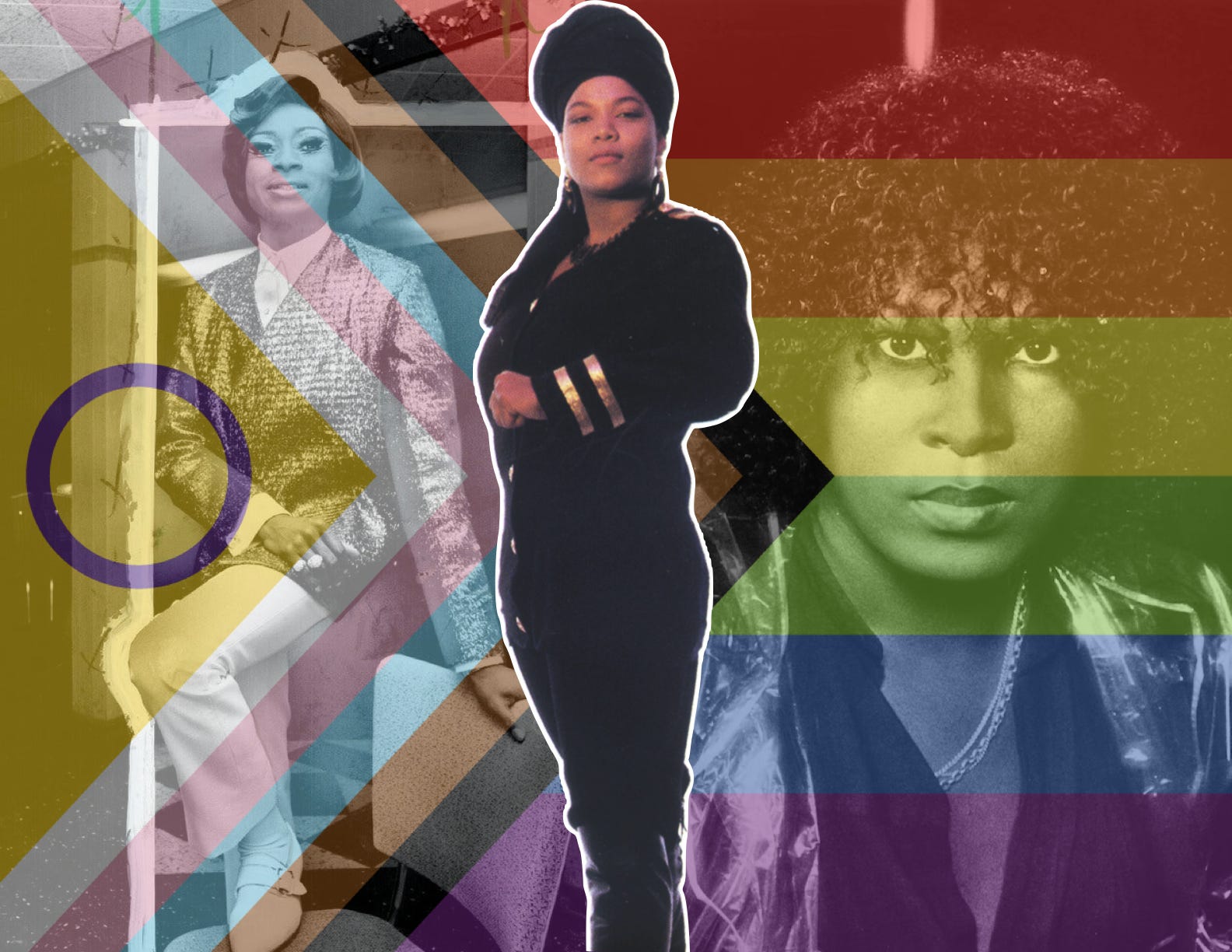
There are many more LGBTQIA+ Black musicians that I haven’t highlighted here. History is richer than a trillionaire, so let this list be a jumping-off point to discover the further riches of culture embedded in the unassuming landscape of recorded music.
I want to thank online archivists for preserving such history, especially the Queer Music Archive.
Spiders On The Keys (1993; recorded 1977-1982)
James Booker, the man who Harry Connick Jr. called “the greatest ever,” was a flamboyant New Orleans rhythm and blues keyboardist who played with The Doobie Brothers, Labelle, and Ringo Starr among others. He gave Connick Jr. piano lessons and, after finding success in Europe like others on this list, he became the house pianist at the Maple Leaf Bar in New Orleans, where this compilation was recorded.
The Flirtations (1990)
The eponymous debut album by The Flirtations (not to be confused with the R&B group of the same name) is full of powerful and inspiring a cappella tracks, including the Labi Siffre-penned anthem “(Something Inside) So Strong.”
House Masters (2015)
DJ, producer and remixer Frankie Knuckles is the Godfather of House Music (which he referred to as “disco’s revenge”). While battling complications from diabetes, Knuckles hand-selected the tracks included on House Masters, the posthumous career retrospective collection, including the monster track “The Whistle Song.”
all available recordings by Gladys Bently
The King of Drag during the Harlem Renaissance, lesbian Gladys Bentley dressed in men’s clothing, accompanied herself on the piano, and entertained crowds for years—even singing the more ribald lyrics directly to the women in attendance. While her overtly queer lyrics were never captured on recordings, her energy and skill absolutely were. Above I’ve embedded a clip of her performing “Them There Eyes” on the comedy quiz series You Bet Your Life, hosted by Groucho Marx, who gets in on the get down.
Johnny’s Greatest Hits (1958) / Merry Christmas (’58) / Heavenly (’59)
Johnny Mathis’s beautiful gay ass has been recording since before the Billboard 200 existed, with 74 studio, 31 compilation, and 3 live albums to his name (6 platinum, 12 more gold). If you like smoother-than-butter crooners, his early discography is a must. Gen Xers and Xillenials might recognize his voice from “Without Us,” covered alongside Deniece Williams in 1982 as the theme song for Family Ties.
Physical Attraction (1978)
The son of a preacher with the voice of an angel, Keith Barrow released his second secular album, with a cover that tells you all you need to know, even if the lyrics only hint at it.
Blackberri and Friends: Finally (1981)
Blackberri was a community activist and death counselor during the HIV epidemic. After being discharged from the armed forces for being gay, he studied voice at the University of Arizona and began writing and performing music, in bands and as a solo artist. Finally was his only full-length solo release.
“You Better Be Fierce” (1983)
“I see ya / Miss Diva” 😎 Ronnie Dyson had a thunderous voice, from his days singing “Aquarius” in the original Broadway cast of Hair. This final track on his final album embraces a queer sensibility.
Chameleon (1976)
Queer icons Labelle (Patti LaBelle, Nona Hendryx, and Sarah Dash)3 had come into their own long before this album, their last before a decades-long hiatus, but bisexual songwriter Hendryx’s pen was rarely better than on songs like “Going Down Makes Me Shiver.” They disbanded after this album and embarked on solo careers, reuniting occasionally for songs like “Turn It Out” for the To Wong Foo, Thanks for Everything! Julie Newmar soundtrack and “Release Yourself” from Patti’s solo album Burnin’.
Any Other Way (1962)
A pioneering transgender performer, Jackie Shane released six singles and one live album. Her biggest hit was a cover of “Any Other Way,” subverting the original lyrics “Tell her that I’m happy / tell her that I’m gay.”
Pure Pleasure (1975)
The Dynamic Superiors, fronted by out vocalist Tony Washington, dropped two albums in 1975. While their self-titled debut made no effort to hide their flamboyance, it’s their second album that had lyrics to match their identity.
“Sissy Blues” (1926)
Ma Rainey’s “Prove It On Me” might be her most famously queer track (fitting her openly queer life), but with lyrics like “a sissy shook that thing and took my man from me,” this particular song is equally iconic in her canon.
anything by Billy Preston (1963-2004)
Billy Preston is one of the most prolific queer artists who was out before his passing. A child prodigy who played piano with Mahalia Jackson and Nat King Cole before he became a teenager, he debuted in 1963 and later performed with the Beatles on Abbey Road (1969) and Let It Be (1970). His solo career produced many R&B and soul hits, and one of his enduring hits is the classic “You Are So Beautiful.”
Living Proof (1979)
Sylvester was a force, vocally and personally, openly speaking about his queerness, wearing clothing and makeup attributed to women, and encouraging the Black community to confront the HIV epidemic, long before it was common or safe to do so. This peak disco-era live album is him at his best, featuring Martha Wash and Izora Rhodes (aka Two Tons O’ Fun, later The Weather Girls) and a crowd ready to get their lives to hits like “You Make Me Feel (Mighty Real)” and “Dance (Disco Heat).”
Baby Dynamite (1969)
The debut album (the first of five) from Aretha’s youngest sister Carolyn Franklin only features two songs written/co-written by the gifted, openly-queer musician: “I Don’t Want to Lose You” and “Boxer.” A lot of Franklin’s lyrics held queer sensibilities, even those she wrote for her sister, including “Angel” and “Ain’t No Way.” When Whitney Houston and Mary J. Blige turned the latter song into a duet at VH1 Divas Live/99 while wearing matching red leather outfits...let’s just say it looked like marriage equality.
“Love Is on the Way” (1996)
Long before Pose and Kinky Boots garnered him hardware, Billy Porter was a vocal beast singing on soundtracks and stages with the same remarkable gift for emoting that made him an eventual household name.
“Lush Life” (1948)
Written by openly gay musician Billy Strayhorn from 1933 to 1936 (between the ages of 18 and 21), this jazz standard was premiered at Carnegie Hall by Strayhorn, the Duke Ellington Orchestra, and vocalist Kay Davis. While Strayhorn wrote several jazz standards (“Take the ‘A’ Train” among them), this is not only the greatest song he wrote but one of the greatest songs ever written in the English language.
My favorite rendition of this song is by Queen Latifah for the Living Out Loud soundtrack, produced and arranged by Mervyn Warren in 1998.
“Come Into My House” (1989)
Even today, icon and über-talent Queen Latifah has not officially come out, nor does she ever need to. Additionally, house music married with New Jack Swing was not exclusive to the queer community by any means (Salt-N-Pepa’s “I Am the Body Beautiful” comes to mind). The difference is that the Queen is undeniably queer, and when undeniably queer meets plausible deniability, it stomps it out. This hit from her debut album could barely hint at the vocal stylings to come, the achingly brilliant acting chops, the legendarily laid hair, the brilliant business mind, and charming persona that have made her a metaphorical house mother to so many.
“Full and Complete” (1990)
Written by Bishop Walter Hawkins, this epic gospel ballad was originally performed by his cousin Shirley Miller and her spouse Yvette Flunder on the Love Alive IV album. As members of the Love Center Choir and The Hawkins Family, Miller and Flunder’s voices led several well-known gospel tunes including “Try Christ,” “I Love You, Lord,” and “Thank You.” Hawkins was a well-known affirmer of queer Christian believers, and Bishop Flunder is still an outspoken queer advocate in the Bay Area.
An Evening at L’Abbaye (1954)
Interracial folk duo (and irl romantic partners) Gordon Heath and Lee Payant recorded several albums in the 50s and 60s, finding great success in France. Heath’s posthumous Deep Are the Roots: Memoirs of a Black Expatriate details the couple’s lives together during the era, among Heath’s other experiences.
Walls to Roses: Songs of Changing Men (1979)
Conceived and produced by alto saxophonist Willie Sordillo, Walls to Roses is a compilation album by queer and straight male artists centered around anti-misogyny and promoting more favorable expressions of masculinity. The album includes two tracks written and performed by the aforementioned Blackberri.
There is a beautiful, brief glimpse into Moi Renee in the short documentary Miss Honey: The Catsuit.
I’m not including songs about queerness from otherwise straight artists, though many of them are fascinating historical curiosities, like Kokomo Arnold’s song “Sissy Man Blues” (“Lord if you can’t send me no woman, please send me some sissy man”), The Meters’ “Cissy Strut” (“where you wave your arms around and switch your booty”) and “Sophisticated Cissy,” and The Miracles’ “Ain’t Nobody Straight in LA” (accurate).
While Patti LaBelle’s name capitalizes the “b,” the band stylized it with a lowercase ‘b.’